300 Teachers Reveal Where Digital Distractions Are Rising Fastest in the US | 2026 SURVEY

A new survey with 300 K12 teachers reveals the latest trends on AI misuse in K12 classrooms, where digital distractions are growing fastest, and which regions are falling behind. The differences between regions and density may surprise you.
HIGHLIGHTS
The Southwest has the highest portion of teachers seeing a large rise in off-task digital behavior in the US. The Southeast sees the lowest % of teachers reporting a large rise. Read more
Urban classrooms see a wider distribution of distractions (3–4 main distraction types) compared to rural (1-2). Read more
Northeast high schools see the lowest rates of filter bypass attempts in the country, despite high population density. Read more
Rural middle schools see the highest spike in bypass attempts, but it drops by 22% in high school. Read more
Only ~35% of Southeast schools have AI policies in place for misuse. Read more
Northeast schools report the highest growth in AI misuse (~83-85%). Read more
Early-career teachers are 2x more likely to report gaming as the largest challenge, compared to veteran teachers. Read more

The Southwest has the highest % of teachers reporting a strong rise in off-task digital behavior

65% of teachers in the Southwest say off-task behavior has strongly grown since 2024. (The highest % in the U.S.)
Everyone agrees that off-task behavior is increasing in general. But the Southwest looks less like a slow trend and more like a step-change (consistent with regions where new tools and behaviors) spread quickly once they hit a tipping point.
This could suggest the Southwest is simply catching up with the rest of the country's rate of off-task digital behavior; especially as AI fuels advanced digital distractions.
Urban classrooms see a wider distribution of distractions (3–4 main distraction types) compared to rural (1-2).

Urban classrooms exhibit a more even distribution of distraction types, with at least 15% of teachers choosing each type. But in rural classrooms, the distribution heavily skews toward YouTube/videos.
45% of teachers in rural classrooms say YouTube/video distractions are the most common type of off-task activity. That's almost 37% more in rural schools than in urban schools.
This may suggest that while rural schools deal with a smaller variety of distractions, the distractions themselves are more prevalent.
Northeast high school teachers see the lowest rates of filter bypass attempts in the country
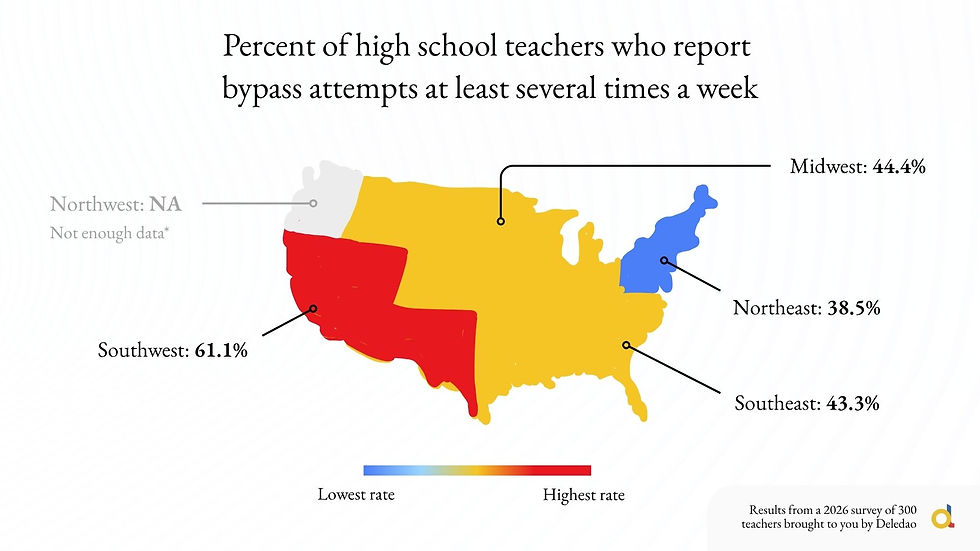
Although the Northeast has the highest population density, its high schools exhibit the lowest rates of off-task attempts in the nation. Only 38.5% of teachers in the Northeast report off-task attempts at least several times a week.
In contrast, 61.1% of Southwest high schools see filter bypass attempts at least several times a week. ~43% of teachers in other regions typically see filter bypass attempts at least several times a week.

A rise in regularly occurring bypass attempts may suggest active circumvention. In these cases, students aren’t simply drifting off-task, but trying to find ways around the filter. Legacy category-based filters are most vulnerable to this challenge.
Rural middle schools see the highest spike in bypass attempts, but it drops by 22% in high school

This is one of the strangest patterns in the dataset. Bypass attempts in rural middle schools spike the highest, over suburban and urban middle schools.
But by high school, the pattern flips. Rural high schools experience a sharp drop in bypass attempts of 22%.
This may be due to many causes. One may be that, once everyone learns the workaround, it stops being “attempting” and becomes routine, or fades if systems adjust.
Suburban Schools Climb from 21% → 53% Bypass Frequency by High School (Highest Trajectory)
Elementary → 21.2%
Middle → 41.9%
High → 52.8%
Suburban schools don’t spike, but rather climb consistently. By high school, they end up with the highest sustained frequency. This “slow boil” pattern tends to be harder to notice (and harder to fix).
Only ~35% of southeast schools have AI policies in place for misuse

Schools prepared for AI misuse cases have a procedure dictated by their AI misuse policy. However, only 30-40% of teachers in Southeast schools have an active policy for AI misuse. This calls to operational readiness.
Policies seem to lag most where:
growth is uneven
responsibility is distributed or unclear
In contrast, over 51-60% of teachers in the Northeast and Pacific Northwest have an active policy for AI misuse; a higher proportion of schools.
Northeast Middle & High Schools Report the Highest AI Misuse Growth (~83-85%)

Northeast middle → 83.6%
Northeast high → ~85.4%
Students aren’t breaking through filters because they don’t have to.
Which could make this harder to detect and harder to regulate.
Only 30% of Teachers Say Students are Distracted Throughout the Day. 70% See a Spike

Distraction may be more predictable during school days than previously thought. Only ~30% of teachers see off-task behavior consistently occurring throughout the day.
About 46% of teachers say off-task behavior spikes somewhere from right before lunch to the final period.
Which lines up suspiciously well with human energy dips.
Early-Career Teachers Are 2x More Likely to Report Gaming the Largest Challenge, Compared to Veteran Teachers

Experience in teaching affects which challenges outrank others. New teachers with less than 5 years of experience are almost 2x more likely to say gaming is the largest challenge, compared to veteran teachers with over 10 years of experience.
Interestingly, teachers with over 10 years of experience are 2.5x more likely to report visibility Issues as the largest challenge, compared to early-career teachers.
Our Takeaway
While AI misuse and digital distractions grow across the country, it's even more important to pinpoint the differing patterns across regions, density, and experience.
We hope this survey gives the mic to teachers to show the true picture on the ground.
The biggest mistake would be treating AI misuse as one problem, because as the survey has shown, it doesn’t behave or scale like one, and it doesn’t show up the same everywhere.