7 New Insights on Student Learning With Tech for 2026

Updated: May 4
By 2026, districts have largely won the political battle against student cell phones. But many are discovering that the bigger distraction risk now lives on the school‑issued device itself.
And the question is shifting from “Should students have devices?” to “How do we keep those devices focused on learning?”
In this post, we’ll unpack seven new insights on student learning with tech in 2026, and what these trends mean for districts rethinking digital distraction, classroom management, and student wellbeing.

1. School Devices Now Outpace Phones as Distractions
In 2025, an EdWeek Research Center study found that 56% of educators see off‑task behavior on school‑issued laptops, tablets, or desktops as a major distraction that cuts into learning time.
School‑issued device misuse is now the second most common source of distraction overall, ranking above personal cell phones, which are cited by 38% of educators.
What this means for 2026
This is a critical shift for technology and curriculum leaders who have invested heavily in 1:1 programs. It means that even as cell phone bans expand, the most disruptive distractions are happening on the very devices schools provide for instruction.
For Deledao customers, this reinforces why contextual, real‑time AI filtering of on‑screen activity, not just domain lists or phone policies, is the baseline to protecting student learning time.
2. 1:1 Computing Is Basically Universal Now
In the 2024–25 school year, 1:1 dominated the landscape. Over 88% of public schools operated a 1:1 computing program, providing every student with a school‑issued device.
This near‑universal access has permanently changed how students experience instruction, assessments, and collaboration.
What this means for 2026
With so much learning mediated by screens, districts can no longer treat “digital distraction” as a fringe problem or something isolated to a few classrooms.
For both prospects and existing Deledao partners, the implication is clear: student learning with personal school-issued devices is here to stay, so any improvement in on‑task behavior at scale can yield outsized gains in academic time and equity.

3. Up to a Quarter of Class Time Is Lost to Distraction
A U.S. Department of Education–funded study reports that an elementary student now spends roughly 25% of classroom time distracted rather than learning.
Other research finds that more than half of all digital distraction causes in K12 are technology‑related, social networking, texting, and gaming, while only 10% are attributed to the instructional environment.
What this means for 2026
For instructional leaders, that fraction of lost time compounds quickly across days, weeks, and years.
Current customers of Deledao appreciate how we help their students stay focused. By detecting and redirecting off‑task activity in real time, districts can reclaim meaningful slices of instructional time without adding another burden to teachers.
When you think of a quarter of the school day lost to distractions, Deledao’s role becomes less about “filtering” and more about restoring access to learning.
4) Behavior and Attention Are Worse Than Pre‑COVID
In late 2024, 48% of educators said student behavior was “a lot worse” than before the pandemic, and 72% reported that it was at least “a little or a lot” worse compared to Fall 2019.
Meanwhile, 80% of teachers report dealing with behavioral problems, many device‑related, at least a few times per week, and more than half say it happens daily.
What this means for 2026
These perceptions go past just student conduct; they signal widening gaps in attention, self‑regulation, and executive function that directly affect learning.
An adaptable and consistent classroom context aims to reduce the cognitive load on teachers who are already juggling behavior management, instruction, and technology integration every period of the day.
5. Gaming and Social Media Beat Absenteeism as Barriers
In one EdWeek Research Center study, STEM teachers ranked online distractions like gaming and social media as a more significant barrier to learning than absenteeism or lack of foundational knowledge.
At the same time, gaming on school‑issued Chromebooks remains a top frustration because students increasingly access games through “legitimate” platforms like Google Sites or GitHub that traditional domain‑based filters struggle to block without over‑blocking needed resources.
What this means for 2026
This is precisely where Deledao’s real-time AI filtering stands apart from legacy approaches.
Rather than blocking entire platforms, Deledao distinguishes between instructional and non‑instructional content, allowing districts to protect student learning with tech in 2026 without shutting down the web’s most powerful tools.
For current customers, these findings can help validate why their teachers report fewer “whack‑a‑mole” battles with gaming links and more time focusing on instruction.
6. Phone Ban Policy Is Catching Up
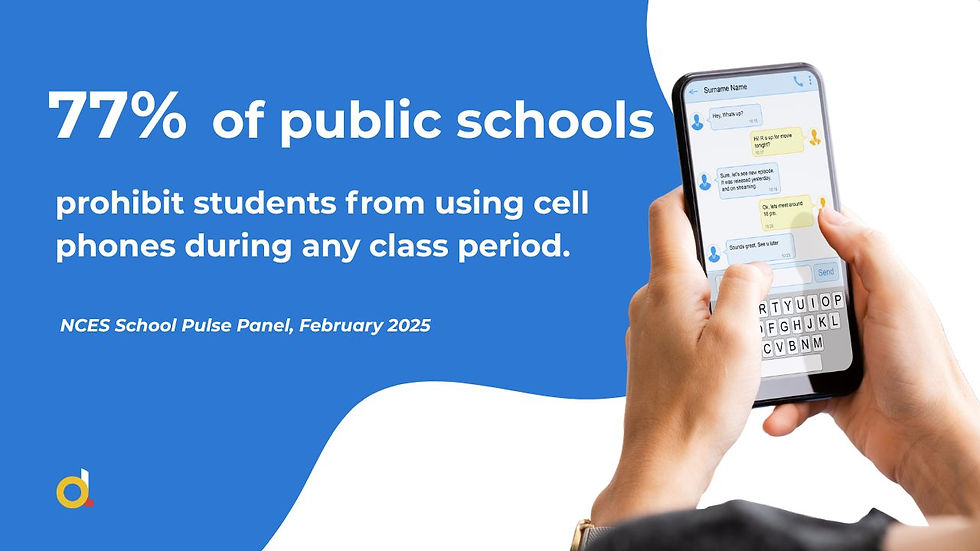
By early 2026, 77% of public schools prohibit students from using cell phones during any class period, with 86% of elementary schools and 55% of high schools enforcing such rules.
At the state level, 26 states now have laws or policies banning or restricting cell phone use in K12 classrooms, and 22 of those were enacted in 2025 alone.
What this means for 2026
In 2024, 68% of U.S. adults supported banning middle and high school students from using cell phones during class.
This rose to 74% support for restrictions in 2025.
Yet even as lawmakers lock phones away, districts still need a way to keep laptops and Chromebooks focused on learning.
7. When Schools Act, Outcomes Improve
In schools that implemented cell phone restrictions, 86% of principals reported positive outcomes, including improved school climate, reduced cyberbullying, and less inappropriate device use.
Notably, about 60% of students themselves support some restrictions during class time because they feel phones interfere with learning and peer relationships.
What this means for 2026
These results show that well‑designed guardrails can improve learning environments without alienating students.
We extend that same philosophy to school‑issued devices: firm but flexible controls can support student agency while keeping the focus on learning.
Research suggests that combining thoughtful policy (around phones) with intelligent technology (on school devices) is the most effective path forward.
How Deledao is Helping Districts Lead Student Learning With Tech in 2026
Across all seven insights, a consistent theme emerges: devices are here to stay.
But without intelligent support, they can quietly erode a quarter of learning time and strain teacher capacity.
That's why the AI‑driven approach is gaining momentum, because it tackles precisely the distractions that traditional filters and phone bans can’t reach:
Gaming hidden on approved platforms
Open tabs that drift off‑task
Content that looks “safe” on paper but derails attention in practice.
For district leaders, this moment is an opportunity to move from reactive blocking to proactive protection of instructional time.
And if you're currently partnered with us at Deledao, consider this a validation that your investment is aligned with the newest insights on student learning with tech in 2026. As always, share your wins with your school boards, communities, and staff.
Sources
Schools Are Enacting Cellphone Policies. Are They Working? (EdTech Magazine, 2025)
public support for classroom phone restrictions (Pew Research Center, 2024)
10 Policy Recommendations to Address Cellphone Use in Schools (American Progress, 2026)
28 States Commit to Phone-Free Classrooms and Schools (ExcelinEd, 2025)